






BMW drivers ask a lot of their cars.
They need to be luxurious, practical and high-tech. But they also need to be sporty and engaging to drive, all without being so firm they shake their passengers' fillings out.
Both the BMW 1 Series and BMW 3 Series fit the bill here, so which one should you buy? We compare them side-by-side to find out. Don't forget, these models and many more are available as nearly new and used cars for sale at Motorpoint.
BMW 1 Series vs 3 Series compared
| BMW 1 Series | BMW 3 Series |
Pros:
| Pros:
|
Cons:
| Cons:
|
Styling and design

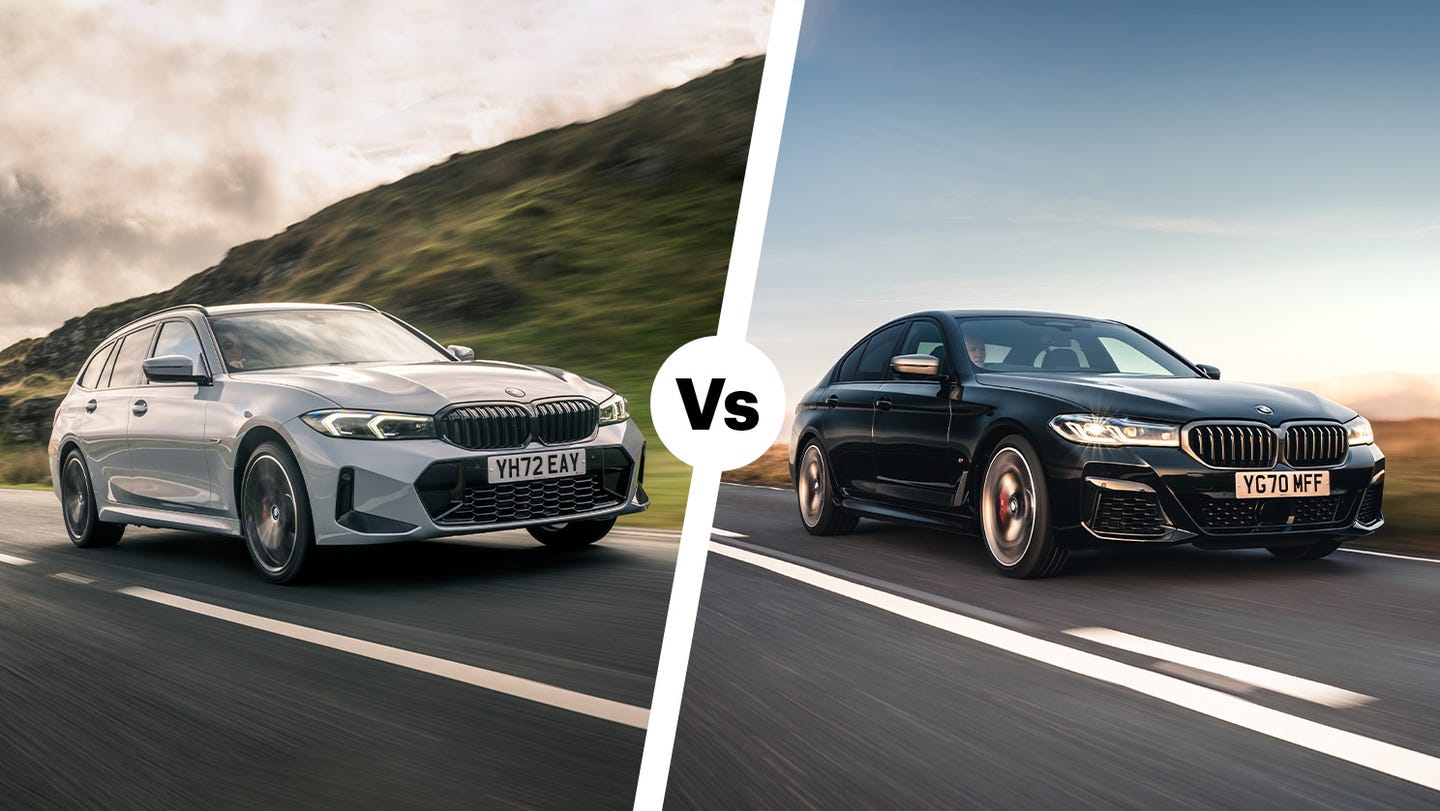
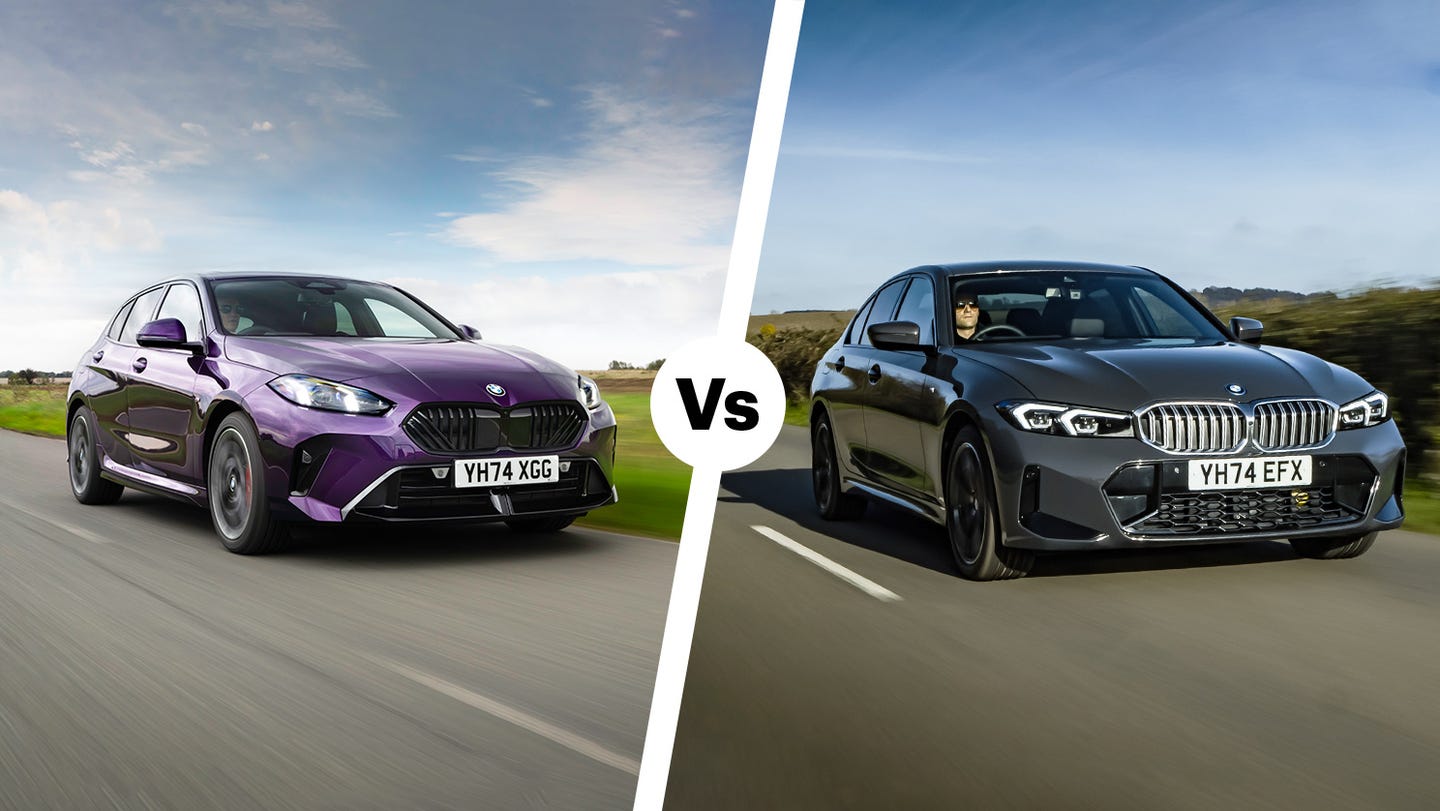
Clearly the most obvious difference is in the body style. The 1 Series is a traditional 'two-box' hatchback design, similar in size to key rivals like the Mercedes A-Class and Audi A3. Meanwhile, the 3 Series is available either as a 'three-box' saloon-style body, or as a long-roof 3 Series Touring estate with a bit more boot space.
A recent heavy facelift has seen the 1 Series' styling become more distinct from the 3 Series and the rest of the BMW lineup. Angular 'kidney' front grilles sit in a simplified front bumper, with pointy, beady headlights positioned above them. There's a soft styling line that runs up the car's flanks, through the door handles, and trails off towards the rear, where you'll find sculpted brakelights that emphasise the car's width.
In comparison, the 3 Series has a slightly more traditional design. Its kidney grilles are a little more subtle and sit in-line with the headlights like other big BMW models. A similar styling line to the 1 Series defines the 3 Series sides and, just like the 1 Series, you can make everything look sportier by picking M Sport trim, which adds a mean body kit and bigger alloy wheels.
Interior and practicality

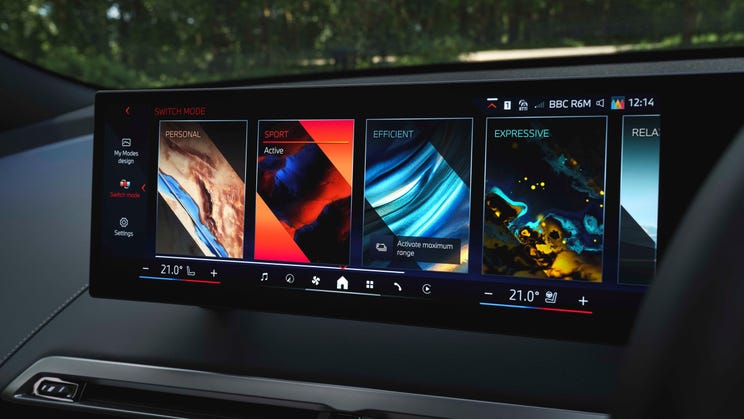
Looking inside, there's clearly a lot of shared DNA between these two cars. Maybe most obvious is the dual-screen infotainment panel that sweeps from behind the steering wheel to the middle of the dashboard. On both cars, these screens look glossy and modern, but we've found BMW's infotainment software to be a bit fiddly and unintuitive in the past. There's not much you can do about this in the 1 Series, but the 3 Series retains a rotary iDrive controller in the centre console that makes the setup easier to use on the move.
Considering the noticeable size difference between the two cars, it won't surprise you to find that the 3 Series is the more practical. There's a bit more leg and elbow room for rear passengers, though headroom is broadly similar between the two cars. The 3 Series has 100 litres more boot space than the 1 Series, but its saloon-style boot lid makes it harder to load bulky objects into the space.
Size and dimensions
| BMW 1 Series | BMW 3 Series | |
| Length | 4,361mm | 4,713mm (+352mm) |
| Width (excl. mirrors) | 1,800mm | 1,827mm (+27mm) |
| Height | 1,459mm | 1,440mm (-19mm) |
| Boot space | 380 litres | 480 litres (+100 litres) |
As you can see, the biggest difference between these two cars is the length – the 3 Series is more than a foot longer than the 1 Series. There's a fairly minimal 27mm difference in width, while the 3 Series is actually 19mm shorter in height than the 1 Series.
The on-paper difference in boot space is noticeable. However, that extra 100 litres doesn't necessarily make the 3 Series that much more practical since you have a less useful saloon-style boot lid, compared to the 1 Series' more useful hatchback-style boot. You can pick the 3 Series Touring estate with its 500-litre capacity and bigger opening if outright carrying capacity is important to you.
Engines and performance

For both cars, BMW has slimmed the engine range down to just the most popular versions. That means a petrol-only lineup for the 1 Series and a choice of petrol or plug-in-hybrid power in the 3 Series.
Starting with the 1 Series, the entry level model is the 170hp 120. With a 7.8-second 0-62mph time, this is plenty of performance for most drivers while retaining the ability to average more than 40mpg. For a bit more pep, you can upgrade to the fairly rare 123 with 218hp and a 6.3-second 0-62mph time. However, the king of the hill is the M135 with 300hp, four-wheel drive and a 4.9-second 0-62mph time.
As for the 3 Series, there's the 184hp 320i, which should be swift enough for most drivers with a 7.4-second 0-62mph time. For commuters or company-car drivers, consider the 330e plug-in hybrid. This has a solid 292hp and a swift 5.9-second 0-62mph time but, if you restrain yourself, can achieve more than 100mpg or cover up to 62 miles on electric power alone.
Ultimate bragging rights go to the M340i and M3. These both feature turbocharged 3.0-litre engines and four-wheel drive for stupendous thrust and a scintillating soundtrack.
Driving

BMWs were once marketed as the 'ultimate driving machines'. However, in recent years, the brand has gone for a more crowd-pleasing all-round setup for its cars.
That might be the case for the 1 Series, but it still definitely feels more sporty, more of the time. The ride is a bit firmer than the 3 Series, and the shorter wheelbase means it thumps over bumps a little more obviously. It's still a bit more sedate than its distant relative, the Mini Hatchback, but you get the impression the 1 Series would relish being thrown at a twisty country road.
Usually, the 3 Series is the sportier car in a comparison test but, here against the 1 Series, it's actually the more rounded vehicle. There's just a touch of extra compliance in the suspension, which means it's the easier of the two to rack up motorway miles in, and it's a fraction less punishing over cracked urban streets. Thankfully, the car's athletic side is still there, with accurate steering and faultless body control.
Value for money

The victory here clearly goes to the 1 Series. This is a car that delivers 95% the experience of a real BMW but for thousands of pounds less than the 3 Series. That gap remains whether you're shopping new or used versions and, with plenty of second-hand 1 Series models available, it's always going to win your wallet.
That said, the 3 Series is more of a definitive BMW experience. That's thanks to its proper rear-wheel-drive setup and slightly more balanced character from behind the wheel. You'll also appreciate the extra space if you've a family to haul around.
Which is best?

Clearly, there's a strong case for the 1 Series. It's a more affordable way into BMW ownership, and it still feels a cut above most other family hatches in the segment.
However, we prefer the overall experience offered by the 3 Series. The more grown-up ride and handling helps it feel more versatile, and we prefer its more traditional body shape.
Big savings on used BMWs
Browse used BMW 1 Series and used BMW 3 Series cars for sale at Motorpoint. For more inspiration, read our list of the best German cars on sale.